Rear Brake Tap in MTB: What It Does (and Why It’s Overrated)
The MTB rear brake tap can slightly lower your front wheel mid-air, but it’s not the magic fix many riders claim. Learn what it actually does, when it works, and better ways to correct front-end angle while jumping.
SKILLS
11/8/20258 min read
Mid-Air Rear Brake Tap: Does It Actually Work on a Mountain Bike?
If you've spent much time learning mountain bike jumping, you've probably heard someone say that if your front wheel gets too high in the air, you should tap the rear brake. The idea is that briefly stopping the rear wheel will help bring the front of the bike back down.
This isn't made up. A rear brake tap really can change the pitch of the bike in the air. I've experimented with it on mountain bikes and also used it a couple of times dirt biking, where the effect was much easier to notice. But on a mountain bike, especially on smaller jumps, the effect isn't nearly as dramatic as you might expect. I think it's a useful technique to understand, but not something I'd want to rely on every time my bike gets out of position.
What Is a Rear Brake Tap?
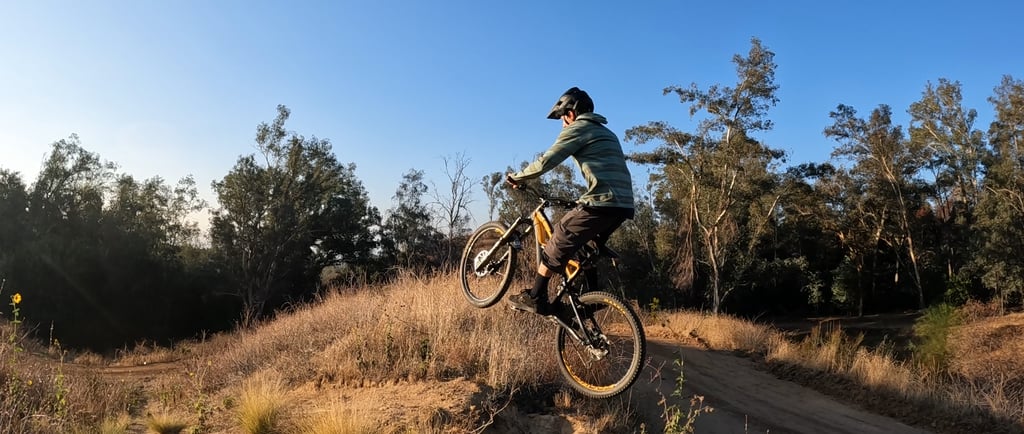
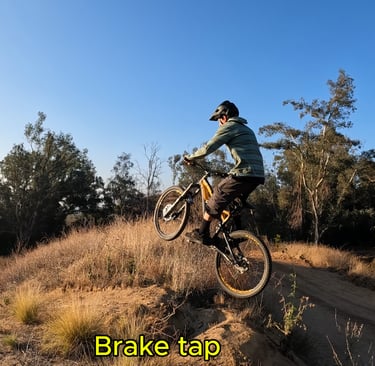
A rear brake tap is exactly what it sounds like. While you're in the air, you quickly apply the rear brake hard enough to slow or briefly stop the rear wheel from spinning, then release it again. Stopping that rotating wheel creates a reaction that can pitch the bike slightly forward, bringing the front wheel down.
This technique is probably more familiar to people coming from motocross, where riders can make noticeable pitch adjustments in the air using the rear brake and throttle. I've used a brake tap dirt biking before, and the effect is much easier to notice. A mountain bike doesn't have an engine and has much lighter wheels, so you're working with a much smaller effect.
Does a Rear Brake Tap Actually Work on an MTB?
Yes, it works. The part I disagree with is how useful people sometimes make it sound. I made a video where I deliberately experimented with brake tapping on different jumps, and on a mountain bike I can feel the effect, but it's fairly subtle. The best way I can describe it is almost like a brief stall in the air as I tap the brake.
On a smaller jump, there's so little airtime that the difference can be difficult to notice. On a bigger jump with more speed and airtime, I can notice the effect more. Even then, it's not like tapping the brake suddenly points the front wheel toward the ground. It's a relatively small adjustment.
That's why I wouldn't think of a brake tap as a magic button for fixing a bad jump. I think of it more as another adjustment you can have available when you already know how to jump and something doesn't go quite as planned.
When Can a Brake Tap Actually Be Useful?
Even though I rarely use one, there are situations where I think a brake tap makes sense. If I came off a big jump unexpectedly front-wheel-high and had plenty of airtime, I might give the rear brake a quick tap to help bring the front down. In that situation, even a small correction could be useful.
I remember watching a Matt Jones video where he was riding with his brother Jono. Matt hit a huge jump and came off with the front wheel high. He used a brake tap and yelled "brake tap" to his brother behind him. I remember seeing that and thinking it was a good example of where the technique really does have a purpose. He was on a huge jump with enough airtime for a small pitch adjustment to actually matter.
So I'm definitely not saying brake taps are useless. I just think they're much more situational on a mountain bike than some simple jumping advice makes them sound.
When I Wouldn't Use a Brake Tap
I also wouldn't automatically use a brake tap on every type of jump. For example, I probably wouldn't want to use one on a hip jump. On a hip I'm already carving, turning the bike, and trying to line myself up with an angled landing. Adding another input by locking the rear wheel isn't something I'd normally want to do unless I absolutely needed it.
I'd also be cautious about using one on certain step-downs. A brake tap can bring the front end down, but you don't always know exactly how much correction you're going to get. On a step-down where you're already dropping toward the landing, bringing the front down more than expected could put you in a worse position. I'd much rather have the bike's pitch right from the takeoff and use normal body and bike movements to make small corrections in the air.
That's another reason I see brake tapping as a tool for specific situations rather than something you should automatically do whenever the front wheel feels high. The type of jump, landing angle, amount of airtime, and what the bike is already doing all matter.
If you're learning how different jump shapes affect your technique, I also have a guide to the 6 Types of Mountain Bike Jumps Every Rider Should Know.
Why Does Tapping the Rear Brake Bring the Front Wheel Down?
There's some physics behind why this works, but you don't need to turn it into a physics lesson to use it. Your rear wheel is spinning while you're in the air. When you suddenly slow that rotation with the rear brake, the reaction creates a small pitching effect on the bike and rider in the opposite direction. The result is that the front end can come down slightly.
How noticeable that is depends on things like wheel speed and how much time you have in the air. That's one reason it makes more sense to me on a large, fast jump than a tiny trail jump where you're barely airborne before it's already time to land.
If you experiment with the technique, remember that you're talking about a quick tap rather than grabbing the rear brake and holding it. You want to release the brake again so the rear wheel can resume spinning before you land.
What I Usually Do Instead
If my front wheel is a little higher than I want in the air, my first instinct usually isn't to reach for the rear brake. I'll normally use my body and move the bike underneath me instead. I may push the bars and bike forward while bringing my upper body farther forward relative to the bike to help level things out.
These movements aren't about somehow moving your entire body and bike forward through the air. You're moving your body and bike relative to each other to influence the bike's position underneath you. Once you've spent enough time jumping, these corrections start to become something you do naturally without thinking through every individual movement.
For me, those body and bike adjustments are much more useful on normal mountain bike jumps. I've been jumping for a long time, and I very rarely find myself thinking, "I need to brake tap this." It's something I know is available, but it isn't one of my primary jumping techniques.
Fix the Takeoff Before Relying on a Brake Tap
There's another important part of this discussion. If your front wheel is constantly getting way too high on jumps, I'd look at why that's happening at the takeoff before trying to solve the problem with the rear brake.
A brake tap can make a small correction after you've already left the ground, but it isn't going to fix poor jumping technique. If you're consistently leaving jumps badly out of balance, work on your body position, timing, pressure through the takeoff, and what you're doing with the bike as you leave the lip.
Mid-air corrections are still important because nobody hits every jump perfectly. But I think it's better to learn how to produce a predictable takeoff first and then treat techniques like brake tapping as additional tools for those times when something doesn't go exactly as planned.
Should Beginners Practice Rear Brake Taps?
I wouldn't make this one of the first things a beginner learns. If you're still working on basic jumping, there are much more important skills to spend your time on. Learn to approach a jump in control, use a balanced takeoff, stay relaxed in the air, and match the landing.
Once you're comfortable jumping and have enough bike control to start experimenting with different mid-air adjustments, then you can try a brake tap somewhere appropriate and see what it feels like. I'd practice it on a jump you're already very comfortable with rather than trying it for the first time because you're getting thrown off balance on something big.
You may be surprised by how little happens, especially on a small jump. That's pretty much what I found when deliberately testing it for my video.
Is Rear Brake Tapping Overrated?
I think overrated is probably a fair description if it's being presented as the solution whenever your front wheel gets too high. The technique itself works. The problem is when a small adjustment gets presented like it's a substitute for good jumping technique.
On a big enough jump, I absolutely see the value in having it available. I've felt the effect myself, I've used it dirt biking, and I've seen skilled riders use it when something goes wrong on a huge jump. That's enough for me to keep it in the toolbox.
But after decades of jumping mountain bikes, it's still something I rarely use. For the majority of normal jumps, I'd rather have good takeoff technique and be comfortable adjusting the bike with my body in the air.
Final Thoughts
A rear brake tap really can help bring the front wheel down while you're airborne on a mountain bike. The effect is caused by suddenly slowing the spinning rear wheel, and it's more noticeable when you're moving faster and have more airtime. On smaller jumps, I've found the effect can be so subtle that you barely notice it.
That doesn't make brake tapping useless. If I hit a big jump, came off unexpectedly front-wheel-high, and had time to make a correction, it's one of the tools I could use. I just wouldn't want it to be the tool I depended on.
Learn to jump well first. Get comfortable making normal mid-air adjustments with your body and bike. Then, once those fundamentals are solid, a rear brake tap is another useful technique to understand for the occasional situation where that little extra correction might be exactly what you need.
Want to Learn More About MTB Jumping?
If you're working on your jumping technique, I go much deeper into takeoffs, body position, timing, common mistakes, different types of jumps, and progressing safely in The Complete Guide to Jumping Mountain Bikes.